
Persian Rug Repair & Restoration
Persian rug repair
and restoration.
Tabriz, Kashan, Isfahan, Heriz, Qum and Bijar. Fringe, selvedge, moth loss, tears and failed foundations rebuilt by hand on the original warp, in our Newark workshop, since 1978.
Fringe and edge work
Fringe re-knotting and hand overcasting. Serging and binding from twenty-two dollars a linear foot. Three to five days on the bench.
Reweaving and moth loss
Priced by the area and the knot count after a free inspection, because that is what the labour follows. Two to six weeks.
Full restoration
Foundation-up work on an antique, scoped rug by rug. Four to twelve weeks.
Written estimate before any work starts, and no site visit needed. See the full pricing table.
The decision
Repair holds a rug together. Restoration rebuilds it.
Repair is stabilising work. Securing an open end so the next row of knots cannot come off, rewrapping a worn selvedge, closing a tear, cleaning out the salts left by a pet accident. It stops the loss where it is. It is the cheap work, and it stays cheap only while there is still something to secure.
Restoration rebuilds what has gone. New warps spliced into sound warps, new wefts beaten down on top of them, then new knots tied in the same knot type and the same density as the original, with wool dyed to the shade the rug is now rather than the shade it left the loom. It is measured in hours at the bench, not in square feet.
Sometimes the answer is no, and we will say so. Repair cost follows labour, not the value of the rug, so a coarse commercial piece can cost more to rebuild than to replace. Cotton that has gone brittle throughout can only be cut out and rewoven, and when the rot is everywhere there is nothing sound left to anchor to. Pile worn evenly across a whole field is, in labour terms, the rug rewoven. And on a piece someone collects rather than uses, heavy reweaving and any recolouring take value off it, because a collector is paying for original condition and honest wear. That assessment comes in writing, before you decide anything.
What it costs
Starting prices and bench times, published.
Edge and fringe work is priced by the linear foot because that is how the labour runs. Reweaving is quoted after inspection, because the same hole costs very different amounts in a sixty-raj Tabriz and in a Heriz field.
Resizing and leather edging are priced on the pricing page. Cleaning is quoted separately, from thirty-five dollars and at $5.99 a square foot for a Persian.
What comes in
Six things that bring a Persian rug to the bench.
In the order we triage them: what is still getting worse is stopped first, what will get worse the moment the rug is walked on again comes second.
Still spreading
Moth loss
Irregular bare patches under furniture or along an edge, sandy grit in the pile, silky tubes at the base of the knots. On a cotton-foundation city rug the larvae eat the wool and leave the warps standing, so the work is re-piling into the rug’s own foundation. On a wool-foundation village piece the foundation goes with it and the job becomes a reweave. Treating the rug does not treat the house. Moth damage repair.
Still spreading
Pet damage and colour run
Urine turns from mildly acidic to alkaline as it breaks down, and that swing works on the dye and the fibre for as long as the salts sit there. We test every colour for fastness before the rug goes near water. Dye that has already migrated is often permanent, and you hear that before we start rather than after. Colour run removal.
Getting worse underfoot
Fringe and kilim ends
The fringe is not decoration sewn onto the end. It is the warp, the yarn the whole rug is tied to, and in front of it sits a plain-woven strip called the kilim end, put there to be sacrificed. Once both are gone, every row of knots that lifts is design that does not come back. The cheapest repair on the bench, and the one people wait longest to book. Fringe repair.
Getting worse underfoot
Selvedge and side cords
The side finish is what stops the wefts pulling out. Some rugs overcast a single cord, others wrap two or more together, and the build changes by region, so a side is matched on cord count and wrapping style, not just colour. A machine serger goes through the fibres rather than around them, which is why there is not one in the building. Overcasting and hand serging.
Structure
Tears, holes and corners
Always two stages. The foundation is rebuilt first, new warps anchored into sound warps and wefts beaten down on them, and only then is pile knotted back in. A corner is the job people underestimate, because a corner is the fringe, the kilim end and the selvedge all failing in the same six inches. Reweaving and patching.
Structure
Dry rot, and old bad repairs
Dry rot is not a fungus, and it announces nothing until the rug is rolled and cracks. It is moisture that has sat in the cotton for years, from a plant pot, a slab, a leak. There is no treatment for rotten cotton; it is cut out and rewoven. Old repairs come off before anything else, because latex and glue fill the foundation so nothing can be woven through it. Full restoration.
Why the weave matters
A Persian rug has to be rewoven, not repaired.
A machine-made rug holds its pile with a latex coat and a backing cloth, so adhesive, binding tape and a serging machine will fix it. A hand-knotted rug has none of that. The knots are held by nothing but their own wrap around the warps and the wefts packed down on top, so every repair has to be woven in, and every shortcut that works on a machine rug does permanent harm here.
The knot itself has to match. Tabriz and Heriz are tied with the symmetric knot; Kashan, Isfahan and Qum with the asymmetric knot, opening to the left. On a Tabriz, a Kashan or a Bijar the alternate warps are pulled down into two levels, and a repair that ignores the depression sits proud of the field no matter how good the colour match is. Density is counted in raj rather than knots per inch, and it is relative to the type: a count that makes a fine Heriz would make a poor Qum.
Then the wool. Repair yarn is spun to the original thickness and twist, and dyed to the shade the rug is now rather than the shade it left the loom, because an antique has softened for eighty years and new wool has not. New pile is knotted to lie the same way as the old, or the patch flashes every time someone walks past it in low sun.
Before & after
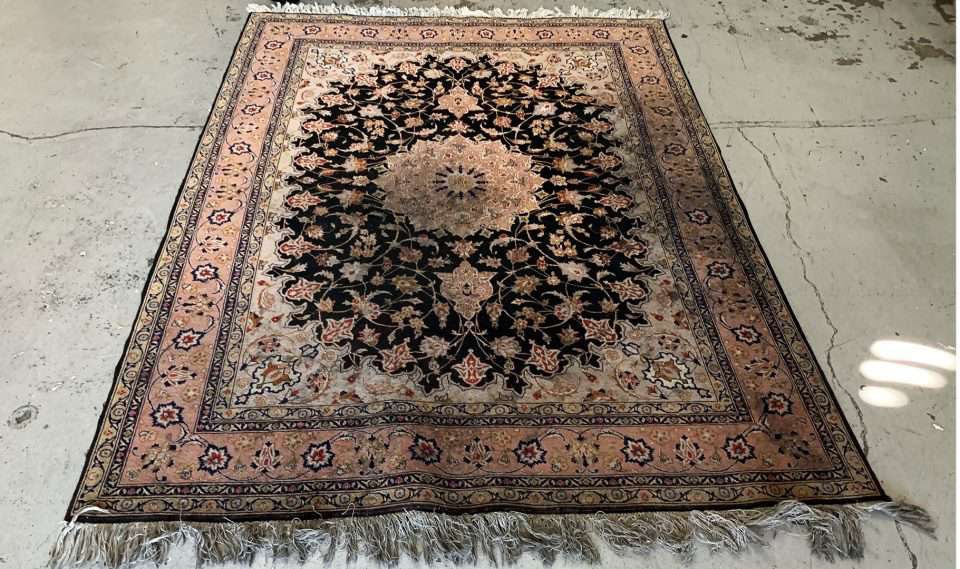
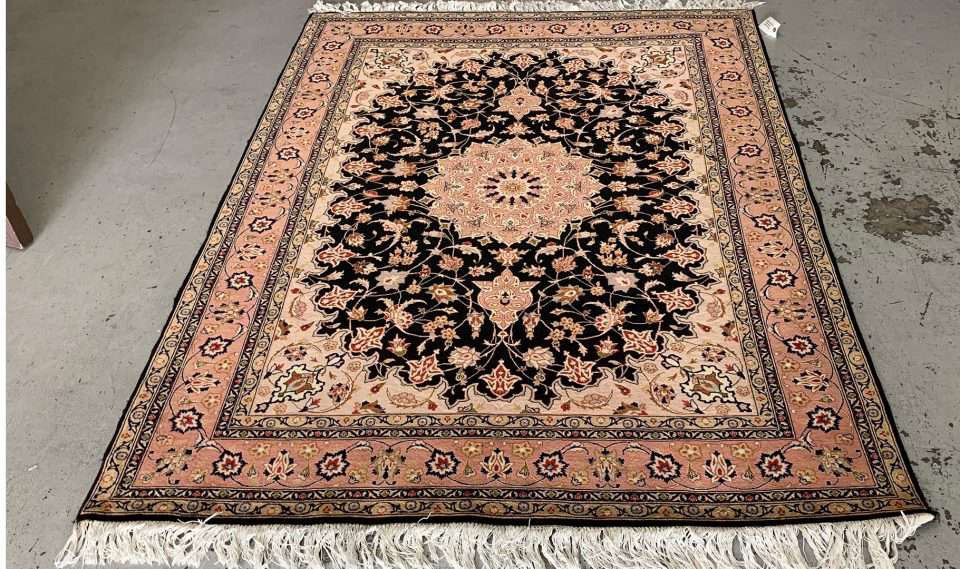
The wash comes first, on every repair.
A Tabriz on the workshop floor, before and after the twelve-step hand wash. Nothing is woven into a dirty rug: grit is an abrasive, salts keep working, and you cannot match a colour you cannot see.
Our process
Five steps, and you approve the figure first.
-
Inspect and photograph
Map the loss, count the knot density, identify the knot type and whether the warps are depressed, and test every colour for fastness before anything gets wet. You get a condition report and an itemised estimate, at no charge.
-
Wash
The twelve-step hand wash, in soft water, with no bleach, no peroxide and no formaldehyde on wool or silk. On a moth case the infestation is dealt with first; on a pet case the wash is what removes the salts doing the damage.
-
Match
Wool spun to the original thickness and twist, dyed against a sample plucked from an inconspicuous corner and checked in daylight, because a match that reads right at the bench can read wrong in the room the rug lives in.
-
Weave
Foundation before pile, always. New warps spliced into sound warps, wefts beaten down, then knots tied in the original type and density. Ends and sides are hand-wrapped.
-
Shear, groom, inspect again
New pile sheared to the height of the field around it and laid in the direction of the nap, then the whole rug checked in daylight. It goes back rolled, never folded.
Before you bring it in
What helps, and what costs you the repair.
Do. Photograph the damage and the whole rug, front and back, in daylight. Take it out of service and stop walking on an open end. If you suspect moths, wrap and seal the rug before carrying it through the house. Blot a fresh spill with white cotton towels from the outside in, cool water only, then dry it flat with air moving over it. Move it rolled around a tube, never folded.
Do not. Do not cut anything, not a loose warp, not a hanging fringe, not a flapping side cord. Every inch cut is warp length the bench needed to anchor a repair. No tape, no glue, no iron-on backing. No bleach, no peroxide, no oxygen boosters, no ammonia, no formaldehyde, ever, on wool or silk. No rented carpet machine and no truck-mount, because hot water and alkaline detergent are how colour run starts. Do not leave it damp, rolled or in plastic, and do not touch up a faded area with marker or dye.
Persian rug repair FAQ
Common questions.
Can a Persian rug be repaired?
Almost always, because a hand-knotted rug is built from materials that can be replaced in kind. Fringe, kilim ends, selvedges, holes, tears, moth loss and worn pile are all rebuildable while there is sound foundation to anchor to. The two honest exceptions are a cotton foundation that has gone brittle across the whole rug, and pile worn evenly down to the foundation everywhere, which in labour terms is the rug rewoven. We say which one you have in the written estimate.
How much does Persian rug repair cost?
Edge and fringe work starts at thirty-nine dollars a linear foot, hand serging and binding at twenty-two, and full restoration from two hundred and ninety-nine dollars. Reweaving is quoted after inspection because the cost follows the work: the area of the loss, the knot density, the number of colours to match, whether the foundation survived, and whether a previous repair has to be undone before the real work starts. A hole in a fine Tabriz medallion is many times the knots of the same hole in a Heriz field, which is why nobody can quote it from a description alone.
Can you restore an antique Persian rug?
Yes, foundation-up, from two hundred and ninety-nine dollars and scoped rug by rug. The question worth asking first is what the rug is for. If it is furniture, restoration puts it back in service and is worth doing. If it is a collector’s piece, securing the ends and sides, washing it and stabilising the weak areas protects its value, while large reweaves and any recolouring can reduce it, because the market pays for original condition and honest wear. We will tell you which side of that line we think you are on before you commit.
How long does Persian rug repair take?
Fringe, overcasting and serging run three to five days on the bench. Colour run work is five to eight days and re-dyeing seven to ten. Reweaving and moth repairs are two to six weeks, and full restoration four to twelve. Moth and pet cases add a wash and, for moths, a treatment cycle before any weaving can start. Those are bench times, and we tell you the queue separately rather than folding it in.
Will the repair show?
The aim is that you have to look for it. Ends and sides, done by hand, are effectively invisible. A field reweave depends on the knot density, the number of colours and whether the pattern repeats; an expert looking at the back can find good work, and a visitor cannot. Two honest notes: new wool and old wool age at different rates, so a repair that disappears today can show a little in ten years, and silk is the hardest thing on the bench to match, because it cannot be dyed to an aged shade the way wool can.
Do I need to bring the rug in for an estimate?
No. Send photographs of the damage and of the whole rug, front and back, with something in frame for scale, and you get a written estimate back. There is no site visit and no charge for the estimate. We collect and return across ninety-three Bay Area cities, and the collection terms are set out here.
Send two photographs
Find out what it costs before you decide.
A photograph of the damage and one of the whole rug is enough for a written estimate. No site visit, no charge, and no work starts until you have approved the figure.
Free written estimate
Get a Persian rug repair estimate.
Fringe, selvedge, moth loss, tears and foundation work, rebuilt by hand in our Newark workshop since 1978. Tell us what happened and we will quote before anything is touched.