Persian Rug Specialists since 1978
Hand-Washed Persian Rug Cleaning. By Origin. By Knot. By Age.
Tabriz, Kashan, Isfahan, Heriz, Bidjar, Qum, Nain, Sarouk. Master cleaner since 1978. Free written estimate. Pickup across the Bay Area.
Oriental Rug Specialists since 1978
Hand-Washed Oriental Rug Cleaning. From Aubusson to Mughal.
Chinese Aubusson, Mughal, Caucasian, Hereke, Bokhara, Agra. Master cleaner since 1978. Free written estimate. Pickup across the Bay Area.
-
Master Cleaner Since 1978 -
Insured in Transit at Stated Value -
Free Bay-Wide Pickup -
Dye-Stability Tested First
Tell us about your
Persian rugOriental rug
A rug specialist responds within 24 hours.
- 1978Family-owned since
- Hand-wash onlyNo machines, no shared tanks
- Per-color testDyes tested before water
- Stated valueInsured in transit
- Bay AreaFree door-to-door pickup
What we see every week
A Tabriz is not a Qum is not a Heriz.
A Chinese Aubusson is not a Mughal is not a Caucasian.
Different regions, different dye traditions, different knot densities, different foundations. A Heriz with its heavy cotton warps and madder-red dyes asks for something a fine silk-highlight Qum will not tolerate — and the reverse.
Different traditions, different fiber blends, different dye stocks, different ages. A Chinese Aubusson with its flat-woven cotton ground asks for something a hand-knotted Mughal silk-pile will not tolerate — and the reverse.
Most cleaners run every rug through the same hot-water tunnel. That is how a hundred-year-old piece comes home an inch shorter on every side, with the indigo bled into the ivory.
This is what walks through our door after the wrong shop has been near it.
Dye bleed
The reds in a Sarouk or Kashan, the indigo in a Bidjar, the madder of a Heriz. Most bleed within 90 seconds of hot-water immersion if no one tested them first.
Foundation shrinkage
Cotton warps tighten in hot water. A 9 x 12 Tabriz can lose two inches per side from a single tunnel-wash, and the foundation never relaxes back.
Pile crush & sheen loss
Rotary scrubbers flatten the knot. Wool loses its lanolin sheen. The silk highlights in a Nain or Isfahan dull permanently.
Curling & cupping
Vertical drying creates tidemarks. Heat-tunnel drying cups the corners. The piece never lies flat again without restretching.
The weaves we hand-wash
We know the difference. The wash plan does too.
Switch between Persian regions and Oriental traditions. Each weave gets a protocol tuned to its dyes, knot count, and foundation.
Tabriz
Fine knot count, often 200–400 KPSI. Cotton foundation. Vegetable-dye fastness tested before water touches the rug.
Kashan
Curvilinear medallions on cotton warps. Famous red dyes — the first colors we wand-test on every Kashan.
Isfahan
High knot count with silk highlights and silk warps on finer pieces. Two protocols inside one wash: wool ground, silk inlay.
Heriz
Heavy cotton warps, large-medallion geometric. Madder reds and indigo blues. Bold dyes, stable when cold-tested, fragile when hot.
Bidjar
The “iron rug.” Wet-loomed, dense as a board. Dries slowly — rushed drying is the most common Bidjar disaster.
Qum
Fine silk and silk-on-cotton. 800–1,200 KPSI. Cold single-tub immersion only. Reds get the longest dye-stability test of any rug we handle.
Nain
Wool field with silk inlays in classic ivory and blue. The silk needs different chemistry than the wool — both happen in one wash.
Sarouk
Dense pile, often dark red ground. Many American-market Sarouks were over-dyed at port — we test for that history first.
Mashad
Large city carpet, wool on cotton, classic red field. Older pieces have the most fugitive Khorasan reds — tested per color.
Bakhtiari
Tribal panel-garden design, wool warps, lanolin-rich pile. Lanolin cleans best in cold water with a low-alkaline soap, by hand.
Karaja
Tribal runners and small carpets. Tighter than a Heriz, looser than a Tabriz. Cold immersion with the nap, never against it.
Serapi
Antique Heriz-region pieces, typically pre-1910. Soft palette of terracotta and ivory. Age dictates the gentlest pre-1930 protocol we run.
Chinese Aubusson
Flat-woven, cotton ground, often with silk weft accents. No knot pile to protect — the risk is dye bleed in the broad pastel fields. Cold wash, per-color test.
Mughal (Indian)
Persian-influenced floral design, often silk-pile on cotton warps. Cold immersion, hand-soap with the nap. Silk inlay protocol on the highlights.
Caucasian
Bold tribal geometrics — Kazak, Shirvan, Kuba, Karabagh. Lanolin-rich wool, vegetable dyes. Cold water; never alkaline detergent.
Turkish Hereke
The finest silk pile of the Oriental tradition, 800–1,200 KPSI. Dedicated single-tub immersion. The blues get the longest test of any color we handle.
Pakistani Bokhara
Dense wool pile, repeating gul motif, often deep red. The fringes are silk on better pieces — handled separately in the final dry.
Indian Agra
Large city carpets, often soft palette on cotton foundation. Older Agras have fugitive lac-reds; per-color stability test before any water.
Why origin matters for cleaning
Three variables decide the wash plan.
Dye source, knot density, and pile composition. They are different in a Heriz than in a Qum, different again in a Chinese Aubusson. The protocol bends — the principles never do.
Vegetal vs. synthetic.
A pre-1930 Serapi’s madder reds and a 1980 Tabriz’s synthetic reds do not behave the same in water. The first wants cold; the second tolerates more. Every distinct color is wand-tested before immersion — no exceptions.
A 19th-century Caucasian’s natural indigo and a mid-century Pakistani Bokhara’s synthetic dye stocks do not behave the same in water. We test per color, and the test result determines water temperature and soak time, not the schedule.
How tight the wash has to be.
A coarse 80-KPSI Bakhtiari handles a vigorous hand-wash. A 600-KPSI Qum cannot. Density determines pressure, brush stiffness, and rinse time — misread it and the knot opens or the pile crushes.
A 1,000-KPSI Hereke silk and a 100-KPSI Caucasian Kazak are washed at opposite ends of the same protocol. Density determines pressure, brush stiffness, and rinse time. Misread it and the knot opens or the pile crushes.
Wool, silk, cotton, mixed.
A Bidjar is all wool on a cotton foundation. A Nain is wool with silk inlays. An Isfahan may be silk-on-silk. Each fiber wants its own chemistry — we treat them separately within one wash, never with one detergent over the lot.
A Chinese Aubusson is cotton-warp flat-weave. A Mughal may be silk-pile. A Bokhara is dense wool. Each fiber wants its own chemistry — we treat them separately within one wash, never with one detergent over the lot.
The cleaning protocol
Five steps. Cold water. No shortcuts.
Every rug we accept follows the same five steps. The variables are the dyes, the knot density, and the age — never the process.
Dye-stability test
Every distinct color is wand-tested in cold distilled water before the rug touches a tub. Fugitive dyes get a stabilizing pre-treatment or we tell you up-front.
Dry dust pass
Years of embedded grit, lifted out of the foundation without water. Wool fibers are abrasive when dry-dirty. This step is non-negotiable.
Cold immersion
Dedicated tub. Under 60°F. pH-balanced rug-safe chemistry. No fine rug shares water with another rug, ever.
Hand-soap with the nap
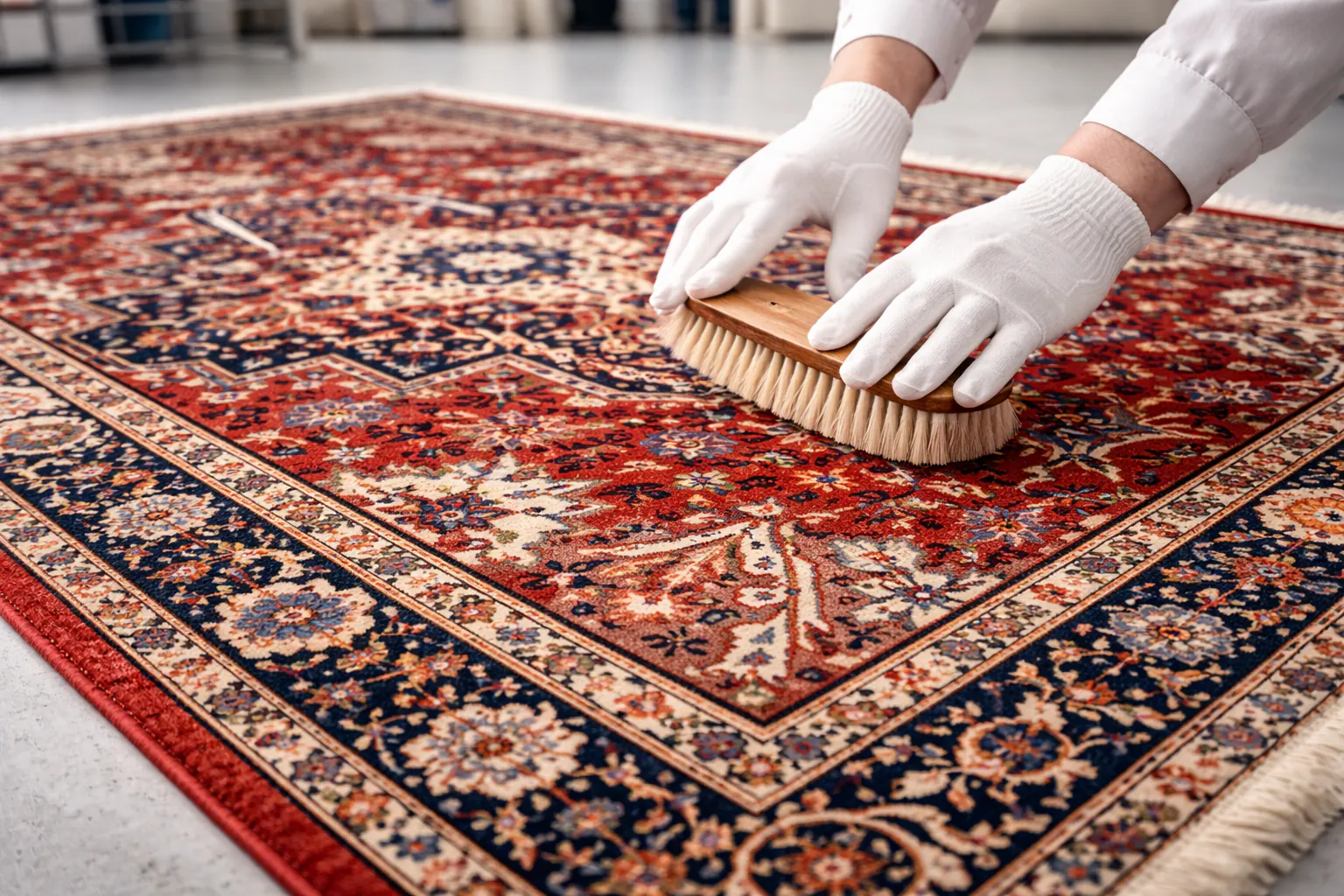
By hand, in the direction of the pile, with the master craftsman’s brush. No rotary equipment touches a hand-knotted rug in our atelier.
Flat dry + certificate
Seventy-two hours, climate-controlled, on a flat sealed bed. Vertical drying creates tidemarks. Certificate of hand-cleaning returned with the rug.
What you receive
Documented at every step.
A Persian or Oriental rug is an asset. We treat it like one — and we give you the paperwork to prove it.
-
Written condition report
Pre-wash assessment with photo documentation of weave, dyes, and any prior damage. -
Dye-stability results
Per-color test results before any water touches the rug. If a color fails, we tell you first. -
Photo doc, before & after
High-resolution photos of every quadrant, before immersion and after sealed flat drying. -
Stated-value transit insurance
Insured pickup and return, at the value you declare — not at a per-pound default. -
Certificate of hand-cleaning
Signed certificate documenting the protocol used. Useful for insurance and appraisal records.
Bay Area collectors & designers
Trusted with rugs worth more than the truck that picks them up.
“An inherited 1920s Tabriz from my grandfather. Two other shops had told me to expect dye bleed in the central medallion. ABC tested every color first, walked me through which reds were borderline, and laid out the plan before they took the rug. It came back the way I remembered it from his living room.”
“A Mughal silk-pile we picked up at auction had a red-wine spill from a dinner party. I had been told to write it off. ABC pulled it cleanly. No halo, no tidemark, no shift in the field. They sent the dye-stability sheet home with the rug.”
“A mixed collection for an Atherton client — a pair of Heriz, an antique Caucasian Kazak, and one Nain with silk inlays. Most shops would have washed them all the same way. ABC built a different plan for each, explained why, and sent back five rugs in better shape than they arrived. That conversation is why I keep going back.”
Written estimate · 24 hours
Forty-seven years of cold-water hand-washing.
Send a photo and the origin. A specialist responds within 24 hours, with a written estimate and the dye-stability plan in plain language.
Free Bay-wide pickup · Stated-value transit insurance · (650) 675-8160
Tell us about your
Persian rugOriental rug
A specialist responds within 24 hours.
The five questions owners ask
Straight answers about hand-washed cleaning.
How long does cleaning take, door-to-door?
Ten to fourteen business days for wool pieces, fourteen to eighteen for silk and silk-blend rugs. The seventy-two-hour sealed flat dry is non-negotiable — rugs dried vertically pick up tidemarks. Pickup days fill up, so booking the slot early shortens the wait, not the protocol.
How much does it cost?
We price per square foot, and the rate depends on the fiber, the knot density, and the condition. A wool Heriz is priced differently than a silk Qum. Send a photo and the origin and we will return a written estimate within 24 hours. No obligation.
How do you avoid dye bleed on antique reds and indigos?
We never guarantee what we have not tested. Every distinct color in the rug is wand-tested in cold distilled water before any immersion. If a color is fugitive, we stabilize it first, or we tell you the color cannot be safely washed. The test results travel with your rug and are returned to you in writing.
Will you take pieces from the 1800s or earlier?
Often, yes. We routinely accept pre-1900 Serapi, Caucasian, and Heriz pieces. Age changes the protocol — older vegetal dyes are tested longer, and the dry phase is extended to protect fragile foundations. If a piece is too fragile for water at all, we will say so before we accept it.
How does Bay Area pickup and return work?
Free pickup and free return across the Bay Area. Padded transit. Stated-value insurance — you tell us the value, we insure to that. Most pickups are scheduled inside three business days. We confirm the protocol with you in writing before the rug leaves the truck for the wash floor.
Free pickup. Free written estimate.
Bring it to a specialist.
Free Bay-wide pickup. Free written estimate. Stated-value transit insurance. Family-owned since 1978.