Antique & heirloom care
Antique Rug
Cleaning,
Bay Area.
Vegetable-dye safe. Hand-spun wool, fragile foundations, family heirlooms. Hand-washed in Newark by the third generation of the Karimi family — insured, appraised, returned to your room.
30-minute callback
Get a free written estimate.
No site visit needed. Send us your antique rug type and a photo if you have one — we’ll quote, schedule pickup, and have it back in 10–14 days.
Why antique rugs need different care
Old rugs are alive.
Treat them like a textile, not a floor covering.
An antique rug — a Heriz from the 1890s, a Bidjar from the 1910s, a Caucasian Kazak from the 1880s — is a textile that has survived a century of foot traffic, climate change and well-meaning cleaning attempts. The wool is hand-spun, the dyes are vegetable-derived, and the cotton or wool foundation is often partially weakened.
Modern detergent strips lanolin and dulls the natural dyes within one wash. Hot water sets madder-red and indigo-blue into a permanent bleed pattern. Spin extraction snaps the brittle warps. Rotary scrubbing crushes the tip of the pile. We don’t do any of that. Every antique rug is treated as a one-of-one conservation project.
Our approach is the opposite of a production line: cold reverse-osmosis water, pH-neutral wool soap, soft natural-bristle brushes worked by hand with the nap, and a slow flat dry. We document the rug end-to-end with photographs before any water touches it, agree a stated value for insured handling, and return a written certificate of cleaning with the rug.
Our antique-safe process
Five stages on every antique rug.
01
Document & appraise
Origin, knot count, weave structure, dye chemistry and current value. Photographed front and back under bench light. Written estimate before any work.
02
Dust without water
Compressed-air dust removal on a padded table. Decades of grit lifted out of the foundation before a single drop of water touches the rug.
03
Color-fastness test
Every color field is swabbed for vegetable-dye fugitivity. Reds, blues and saffrons are tested first — they are the most reactive.
04
Cold hand wash
Cold reverse-osmosis water in a single tub. pH-neutral wool soap by hand, with the nap, with soft horsehair brushes. No machine touches the rug.
05
Slow flat dry & certificate
Three to four days flat in our climate-controlled drying loft. Pile groomed by hand. Wrapped in acid-free tissue, returned with a signed certificate of cleaning.
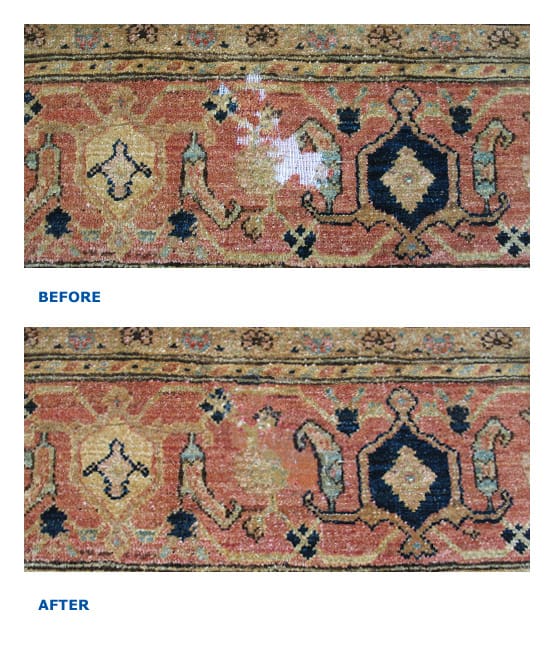
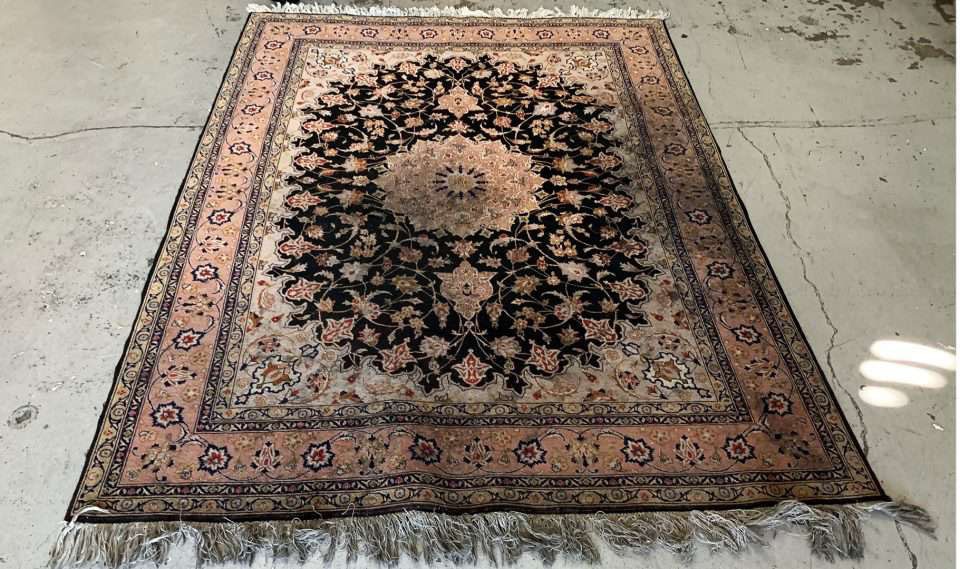
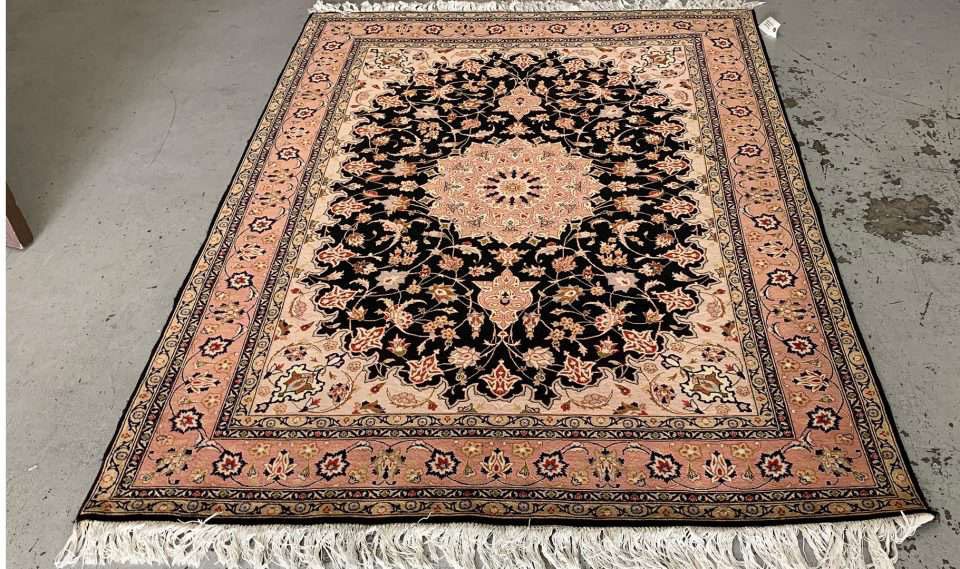
Before & after
A 1900s Heriz, refreshed.
Vegetable-dyed wool, hundred-year traffic on the field, brought back without a single dye bleed.
Insured. Appraised. Documented.
Antique rugs deserve the paperwork.
Stated-value insurance
Full value, in transit and on the bench
Every antique rug is picked up under a stated-value insurance rider. The figure is agreed with you on inspection. Our insurance pays at full stated value for any loss or damage.
Written appraisal
For insurance, estate and resale
A certified written appraisal documents origin, age, knot count, materials, condition and replacement value. Used for homeowner riders, estate planning and probate. Learn more about appraisals ›
Certificate of cleaning
Returned with the rug
A signed, dated certificate documents the protocol used, the date of treatment and the master who oversaw the wash. Useful for insurance riders and resale provenance.
Antique rugs we work on every week
Eight regions, one cold-water protocol.
- Persian Heriz, Bidjar, Tabriz, Kashan and Sarouk — 1880s through 1940s.
- Caucasian Kazak, Shirvan, Kuba and Daghestan tribal rugs.
- Turkish Hereke, Konya, Oushak and prayer rugs — silk and wool.
- Turkmen Tekke, Yomud and Salor — tight-knot tribal pieces.
- Chinese Art Deco from Tianjin, Beijing and Peking.
- Indian Agra and Amritsar — large-scale palace and Victorian-era rugs.
- Northwest Persian Senneh kilims and flat-weaves.
- European needlepoint, Aubusson and Savonnerie pile rugs.
Service areas
Insured antique pickup across the Bay Area.
Questions
What collectors usually ask first.
How do I know if my rug is antique?
The trade definition is one hundred years or older — so anything woven before 1926 today. Semi-antique generally means fifty years or older. Hand-spun wool, vegetable dyes and irregular pile depth are good visual markers, but the only way to know for certain is to look at the back of the rug under a strong light. Bring it in or send a photo.
Will the colors run?
The point of testing every color field with a neutral swab before water is to know that answer for your rug specifically. Vegetable dyes — madder, indigo, weld, walnut — are stable when properly mordanted, but late-19th-century early-synthetic dyes can be fugitive. We test, then choose the wash plan.
Can you clean a rug with existing pile loss or holes?
Yes. We clean first, then assess the damage on the bench. If the rug needs reweaving we quote it as a separate line item. See our reweaving service — same craftspeople, same atelier.
How long does it take?
Ten to fourteen business days door-to-door for cleaning alone. Antique rugs cannot be rushed through drying — three to four days flat is the minimum to avoid cupping or fringe curl.
Is the rug insured during pickup and on the bench?
Yes. Every antique rug is covered under a stated-value insurance rider. We agree the value with you on intake. The rider covers transit and time on the bench.
Do you do appraisals at the same time?
Yes. Written appraisals for insurance, estate or resale purposes are a separate line item. See our appraisal service ›
How often should an antique rug be cleaned?
Every five to seven years for a low-traffic display piece. Every three to five years for an everyday rug. Vacuuming bi-weekly with a low-suction setting and the beater bar off is the most important care between washes.
More on our process
The antique protocol is built on the same hand-wash discipline as our 12-step Persian process. For damage on antique pieces see restoration, reweaving and fringe repair. Browse all cleaning services or book a free insured pickup. Serving Palo Alto, Berkeley, Oakland and San Francisco.
Book your pickup
The next step is the easy one.
Tell us about your antique rug. We respond within 24 hours with an insured pickup window and a written estimate.